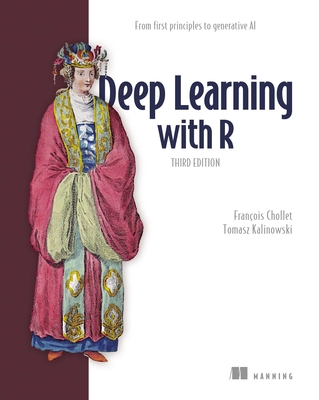
Deep Learning with R : From First Principles to Generative AI, 3/e (Paperback)
暫譯: 使用 R 的深度學習:從基本原則到生成式 AI,第三版(平裝本)
Chollet, François, Kalinowski, Tomasz
- 出版商: Manning
- 出版日期: 2026-06-02
- 售價: $3,080
- 貴賓價: 9.5 折 $2,926
- 語言: 英文
- 頁數: 648
- 裝訂: Quality Paper - also called trade paper
- ISBN: 1633435180
- ISBN-13: 9781633435186
-
相關分類:
DeepLearning、R 語言
海外代購書籍(需單獨結帳)
相關主題

商品描述
Get the eBook free when you register your print book at Manning.
This book introduces deep learning from scratch with examples that use the R language and the Keras library. Each chapter offers practical code examples that build your understanding of deep learning layer by layer. You'll appreciate the intuitive explanations, crisp illustrations, and clear examples. In this expanded third edition you'll find fresh chapters on the transformers architecture, building your own GPT-like large language model, and image generation with diffusion models. Plus, even DL veterans will benefit from the insightful explanations on the nature of deep learning.
For R programmers, the R interface to the Keras deep learning library is a powerful head start on building deep learning models without switching to Python. It provides a simple, consistent API that makes deep learning accessible and simplifies the process of building neural networks, even if you have no prior experience in advanced machine learning.
In Deep Learning with R, Third Edition you will learn:
- Deep learning from first principles
- The latest features of Keras
- Image classification and image segmentation
- Time series forecasting
- Text classification and machine translation
- Text and image generation--build your own LLMs and diffusion models!
- Scaling and tuning models
About the technology
Deep Learning with R, Third Edition is a practical, concept-driven introduction to modern deep learning for R users. With a focus on clarity, intuition, and hands-on experimentation, it guides you from the foundations of deep learning to advanced architectures such as transformers and LLMs. This book treats R as a fully capable environment for modern deep learning, showing how contemporary models and workflows can be developed end to end without compromise.
About the book
Deep Learning with R, Third Edition gets you up to speed with the current state of deep learning practice. Using Keras 3 with R, you'll build and train neural networks from scratch, work with transformers, fine-tune pretrained models and explore large language models and diffusion-based image generation. By following carefully constructed examples that build insight step-by-step, you'll develop a deep understanding of why these models work--not just how to use them.
What's inside
- Hands-on, code-first learning in R
- A clear progression from deep learning fundamentals to generative AI
- Examples that emphasize intuition and understanding
About the reader
For readers with intermediate R skills. No prior experience with deep learning is required.
About the author
François Chollet is the creator of Keras and author of Deep Learning with Python. Tomasz Kalinowski is a software engineer at Posit Software, PBC and maintainer of the Keras and TensorFlow R packages.
Table of Contents
1 What is deep learning?
2 The mathematical building blocks of neural networks
3 Introduction to TensorFlow, PyTorch, JAX, and Keras
4 Classification and regression
5 Fundamentals of machine learning
6 The universal workflow of machine learning
7 A deep dive into Keras
8 Image classification
9 Convnet architecture patterns
10 Interpreting what convnets learn
11 Image segmentation
12 Object detection
13 Timeseries forecasting
14 Text classification
15 Language models and the Transformer
16 Text generation
17 Image generation
18 Best practices for the real world
19 The future of AI
20 Conclusions
商品描述(中文翻譯)
在Manning註冊您的印刷書籍時可免費獲得電子書。
本書從零開始介紹深度學習,並使用R語言和Keras庫的範例。每一章都提供實用的程式碼範例,逐層建立您對深度學習的理解。您將會欣賞到直觀的解釋、清晰的插圖和明確的範例。在這個擴展的第三版中,您將發現有關變壓器架構、構建自己的類GPT大型語言模型以及使用擴散模型進行圖像生成的新章節。此外,即使是深度學習的老手也能從對深度學習本質的深刻解釋中受益。
對於R程式設計師來說,R與Keras深度學習庫的介面是一個強大的起點,可以在不切換到Python的情況下構建深度學習模型。它提供了一個簡單、一致的API,使深度學習變得可及,並簡化了構建神經網絡的過程,即使您在高級機器學習方面沒有任何經驗。
在Deep Learning with R, Third Edition中,您將學到:
- 從基本原則學習深度學習
- Keras的最新功能
- 圖像分類和圖像分割
- 時間序列預測
- 文本分類和機器翻譯
- 文本和圖像生成——構建自己的LLMs和擴散模型!
- 模型的擴展和調整
關於技術
Deep Learning with R, Third Edition是一本針對R用戶的現代深度學習實用概念導向入門書籍。它專注於清晰性、直觀性和實驗性,指導您從深度學習的基礎到變壓器和LLMs等高級架構。本書將R視為現代深度學習的完全能力環境,展示如何從頭到尾開發當代模型和工作流程,而不妥協。
關於本書
Deep Learning with R, Third Edition讓您迅速了解當前深度學習實踐的狀態。使用Keras 3和R,您將從零開始構建和訓練神經網絡,使用變壓器,微調預訓練模型,並探索大型語言模型和基於擴散的圖像生成。通過仔細構建的範例,逐步建立洞察力,您將深入理解這些模型為何有效——不僅僅是如何使用它們。
內容概覽
- 實作為主的R程式碼學習
- 從深度學習基礎到生成式AI的清晰進展
- 強調直觀和理解的範例
關於讀者
適合具備中級R技能的讀者。不需要有深度學習的先前經驗。
關於作者
François Chollet是Keras的創建者,也是Deep Learning with Python的作者。Tomasz Kalinowski是Posit Software, PBC的軟體工程師,並且是Keras和TensorFlow R套件的維護者。
目錄
1 深度學習是什麼?
2 神經網絡的數學基礎
3 TensorFlow、PyTorch、JAX和Keras簡介
4 分類和回歸
5 機器學習的基本原則
6 機器學習的通用工作流程
7 深入了解Keras
8 圖像分類
9 卷積網絡架構模式
10 解釋卷積網絡學到的東西
11 圖像分割
12 物體檢測
13 時間序列預測
14 文本分類
15 語言模型和變壓器
16 文本生成
17 圖像生成
18 實際應用的最佳實踐
19 AI的未來
20 結論
作者簡介
François Chollet is the author of Keras, one of the most widely used libraries for deep learning in Python. He has been working with deep neural networks since 2012. Francois is currently doing deep learning research at Google. He blogs about deep learning at blog.keras.io.
Tomasz Kalinowski is a software engineer at RStudio and maintainer of the Keras and Tensorflow R packages.
作者簡介(中文翻譯)
François Chollet 是 Keras 的作者,Keras 是 Python 中最廣泛使用的深度學習庫之一。他自 2012 年以來一直在從事深度神經網絡的研究。Francois 目前在 Google 進行深度學習研究。他在 blog.keras.io 上撰寫有關深度學習的博客。
Tomasz Kalinowski 是 RStudio 的軟體工程師,也是 Keras 和 Tensorflow R 套件的維護者。