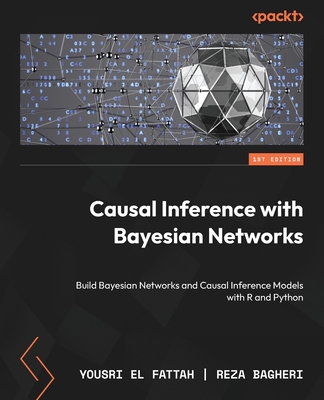
Causal Inference with Bayesian Networks: Build Bayesian Networks and Causal Inference Models with R and Python
暫譯: 使用貝葉斯網絡進行因果推斷:使用 R 和 Python 構建貝葉斯網絡及因果推斷模型
Fattah, Yousri El, Bagheri, Reza
- 出版商: Packt Publishing
- 出版日期: 2026-05-29
- 售價: $1,890
- 貴賓價: 9.5 折 $1,795
- 語言: 英文
- 頁數: 686
- 裝訂: Quality Paper - also called trade paper
- ISBN: 1835084982
- ISBN-13: 9781835084984
-
相關分類:
R 語言、Python
海外代購書籍(需單獨結帳)
商品描述
Learn Bayesian networks, graphical models, and causal inference for probabilistic reasoning, treatment effect estimation, and decision-making using observational data with hands-on examples in R and Python.
Key Features:
- Apply Bayesian networks for probabilistic and causal inference.
- Estimate causal effects from observational data using machine learning.
- Build practical causal inference workflows in R and Python.
Book Description:
This practical guide explores Bayesian networks, graphical models, and causal inference for probabilistic reasoning and treatment effect estimation using real-world data. You'll learn Bayesian networks, conditional independence, structural causal models (SCM), and intervention-based reasoning for causal analysis. The book explains how graphical models support probabilistic inference, decision-making, and knowledge representation across healthcare, economics, epidemiology, finance, and social sciences.
You'll work with probabilistic inference methods such as variable elimination, tree clustering, and Bayesian network reasoning. For causal inference, the book covers Pearl's do-calculus, backdoor and front-door criteria, causal effect identification, and treatment effect estimation using observational data. You'll also explore the potential outcomes framework and machine learning approaches for causal inference, including meta-learners for estimating conditional average treatment effects and heterogeneous treatment effects.
Practical examples and exercises in R and Python help reinforce concepts and build implementation skills for causal modeling workflows. By the end of the book, you'll be able to design Bayesian network models, perform probabilistic and causal inference, and develop practical causal analysis applications for evidence-based decision-making.
What You Will Learn:
- Build Bayesian networks for knowledge representation
- Interpret conditional independence in graphical models
- Apply causal reasoning with structural causal models
- Perform probabilistic inference with Bayesian networks
- Identify and estimate causal treatment effects
- Use machine learning methods for causal inference
- Implement probabilistic and causal models in R and Python
Who this book is for:
This book will serve as a valuable resource for a wide range of professionals including data scientists, software engineers, policy analysts, decision-makers, information technology professionals involved in developing expert systems or knowledge-based applications that deal with uncertainty, as well as researchers across diverse disciplines seeking insights into causal analysis and estimating treatment effects in randomized studies. The book will enable readers to leverage libraries in R and Python and build software prototypes for their own applications.
Table of Contents
- A Guided Tour of Book Topics
- Probability and Bayes' Theorem
- Bayesian Networks
- Structural Causal Models
- Relational Database Models
- Join Tree Clustering
- Probabilistic Inference with Join Tree Clustering
- Probabilistic Inference with Relational Database Models
- Causal Inference with Structural Causal Models
- Causal Inference with Observational Data
- Causal Inference with Machine Learning
- Causal Inference in Economic Research
- Causal Inference in Epidemiology
- Causal Inference in Social Science Research
商品描述(中文翻譯)
學習貝葉斯網路、圖形模型和因果推斷,以進行機率推理、治療效果估計和使用觀察數據的決策制定,並透過 R 和 Python 的實作範例進行實踐。
主要特點:
- 應用貝葉斯網路進行機率和因果推斷。
- 使用機器學習從觀察數據中估計因果效果。
- 在 R 和 Python 中建立實用的因果推斷工作流程。
書籍描述:
本實用指南探討貝葉斯網路、圖形模型和因果推斷,以進行機率推理和使用真實世界數據的治療效果估計。您將學習貝葉斯網路、條件獨立性、結構因果模型(SCM)以及基於干預的推理進行因果分析。本書解釋了圖形模型如何支持機率推理、決策制定和知識表示,涵蓋醫療保健、經濟學、流行病學、金融和社會科學等領域。
您將使用機率推理方法,如變數消除、樹狀聚類和貝葉斯網路推理。對於因果推斷,本書涵蓋 Pearl 的 do-calculus、後門和前門標準、因果效果識別以及使用觀察數據的治療效果估計。您還將探索潛在結果框架和因果推斷的機器學習方法,包括用於估計條件平均治療效果和異質治療效果的元學習者。
R 和 Python 中的實用範例和練習有助於鞏固概念並建立因果建模工作流程的實作技能。到書籍結束時,您將能夠設計貝葉斯網路模型,執行機率和因果推斷,並開發基於證據的決策制定的實用因果分析應用。
您將學到的內容:
- 建立貝葉斯網路以進行知識表示
- 解釋圖形模型中的條件獨立性
- 應用結構因果模型進行因果推理
- 使用貝葉斯網路執行機率推理
- 識別和估計因果治療效果
- 使用機器學習方法進行因果推斷
- 在 R 和 Python 中實作機率和因果模型
本書適合誰:
本書將成為廣泛專業人士的寶貴資源,包括數據科學家、軟體工程師、政策分析師、決策者、從事開發專家系統或處理不確定性的知識型應用的資訊技術專業人員,以及尋求因果分析和在隨機研究中估計治療效果的各學科研究人員。本書將使讀者能夠利用 R 和 Python 中的庫,並為自己的應用程式建立軟體原型。
目錄
- 書籍主題導覽
- 機率與貝葉斯定理
- 貝葉斯網路
- 結構因果模型
- 關聯資料庫模型
- 連接樹聚類
- 使用連接樹聚類的機率推理
- 使用關聯資料庫模型的機率推理
- 使用結構因果模型的因果推斷
- 使用觀察數據的因果推斷
- 使用機器學習的因果推斷
- 經濟研究中的因果推斷
- 流行病學中的因果推斷
- 社會科學研究中的因果推斷