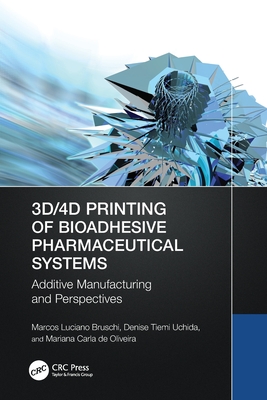
3d/4D Printing of Bioadhesive Pharmaceutical Systems: Additive Manufacturing and Perspectives
暫譯: 生物黏附藥物系統的3D/4D列印:增材製造與展望
Bruschi, Marcos Luciano, Uchida, Denise Tiemi, Carla de Oliveira, Mariana
商品描述
This book features a brief history of additive manufacturing and 3D/4D printing techniques, as well as the advantages, applications, and overall challenges facing the technology. It then focuses on the applications of bioadhesive systems for drug delivery.
3D/4D Printing of Bioadhesive Pharmaceutical Systems: Additive Manufacturing and Perspectives, explores recent discoveries of 3D printing in the development of pharmaceutical systems and drug delivery. Specifically, it discusses the main polymers/materials used in the development of bio-adhesive pharmaceutical systems and explains the importance of bio-adhesiveness of drug release through 3D printing. The authors also introduce the main strategies necessary to achieve a proper drug delivery system through 3D printing, and examine the adhesiveness of these systems on the skin as the mucosa decreases with the elimination of the drug by the body. Finally, the book brings all the necessary specifications to obtain a bioadhesive system with suitable bio-ink to obtain the best 3D/4D printing.
This book is written with the objective of helping students start their studies in pharmaceutical engineering, bioengineering and additive manufacturing. Moreover, engineering professionals can use the book to improve the performance of 3D/4D printers for this type of system.
商品描述(中文翻譯)
本書簡要介紹了增材製造及3D/4D列印技術的歷史,以及該技術所面臨的優勢、應用和整體挑戰。接著,重點探討了生物黏附系統在藥物傳遞中的應用。
《3D/4D生物黏附藥物系統的列印:增材製造與前景》探討了3D列印在藥物系統和藥物傳遞開發中的最新發現。具體而言,本書討論了在生物黏附藥物系統開發中使用的主要聚合物/材料,並解釋了通過3D列印實現藥物釋放的生物黏附性的重要性。作者還介紹了通過3D列印實現適當藥物傳遞系統所需的主要策略,並檢視這些系統在皮膚上的黏附性,因為隨著藥物被身體排除,黏膜會減少。最後,本書提供了獲得適合的生物墨水以實現最佳3D/4D列印的生物黏附系統所需的所有規格。
本書的目的是幫助學生開始他們在藥物工程、生物工程和增材製造方面的學習。此外,工程專業人士也可以利用本書來提升這類系統的3D/4D列印機的性能。
作者簡介
Marcos Luciano Bruschi is an Associate Professor in the Department of Pharmacy at the State University of Maringa (UEM), Parana, Brazil. Dr. Bruschi joined the university in 1998 as Assistant Professor of Pharmaceutics and became Associate Professor in 2014. He was awarded the degree of Doctor in Pharmaceutical Sciences from School of Pharmacy, University of Sao Paulo (USP), with a period as research fellow at Queen's University of Belfast (QUB), Northern Ireland, UK. In 2014, he returned to QUB to complete a period of post-doctoral studies in School of Pharmacy. His current research focuses on the development of drug delivery systems using different strategies to modify and control the drug delivery, including nanotechnology and the development of advanced thermoresponsive bioadhesive platforms, micro/nanostructured particles, 3D printing, natural products, and photodynamic therapy. He is the coordinator of the Laboratory of Research and Development of Drug Delivery Systems (LABSLiF) at the State University of Maringa.
Denise Tiemi Uchida is a PhD student in Pharmaceutical Sciences working on the development of bioadhesive drug delivery systems by 3D printing in the Laboratory of Research and Development of Drug Delivery Systems (LABSLiF) at the State University of Maringa, Brazil.
Mariana Carla de Oliveira is a PhD student in Pharmaceutical Sciences working on the development of controlled drug delivery systems in the Laboratory of Research and Development of Drug Delivery Systems (LABSLiF) at the State University of Maringa, Brazil.
作者簡介(中文翻譯)
馬爾科斯·盧西亞諾·布魯斯基是巴西巴拉那州馬林加州立大學(UEM)藥學系的副教授。布魯斯基博士於1998年加入該大學,擔任藥劑學助理教授,並於2014年晉升為副教授。他在聖保羅大學(USP)藥學院獲得藥學博士學位,並曾在英國北愛爾蘭的貝爾法斯特女王大學(QUB)擔任研究員。2014年,他回到QUB完成藥學院的博士後研究。他目前的研究重點是開發藥物傳遞系統,使用不同的策略來修改和控制藥物釋放,包括納米技術、先進的熱響應生物黏附平台、微/納米結構顆粒、3D列印、天然產品和光動力療法。他是馬林加州立大學藥物傳遞系統研究與開發實驗室(LABSLiF)的負責人。
田美惠·內田是巴西馬林加州立大學藥學科學的博士生,專注於在藥物傳遞系統研究與開發實驗室(LABSLiF)中通過3D列印開發生物黏附藥物傳遞系統。
瑪麗安娜·卡爾拉·德·奧利維拉是巴西馬林加州立大學藥學科學的博士生,專注於在藥物傳遞系統研究與開發實驗室(LABSLiF)中開發控制釋放藥物傳遞系統。