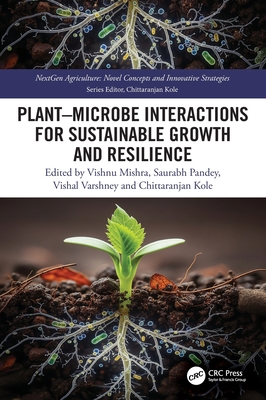
Plant-Microbe Interactions for Sustainable Growth and Resilience
暫譯: 植物-微生物互動促進可持續成長與韌性
Mishra, Vishnu, Pandey, Saurabh, Varshney, Vishal
- 出版商: CRC
- 出版日期: 2026-05-18
- 售價: $7,740
- 貴賓價: 9.5 折 $7,353
- 語言: 英文
- 頁數: 366
- 裝訂: Hardcover - also called cloth, retail trade, or trade
- ISBN: 1032989823
- ISBN-13: 9781032989822
尚未上市,無法訂購
相關主題

商品描述
This book reviews dynamic relationships between plants and microbes, highlighting their roles in enhancing crop resilience, growth, and productivity. Integrating research and practical insights, the book provides solutions to pressing agricultural challenges, including soil degradation, pest resistance, and nutrient inefficiency. It discusses plant-microbe interactions; regulation of the host-microbe interaction by small RNA molecules and their mechanisms; and applications of sustainable crop production and climate-resilient agriculture. The book covers a broad spectrum of plant-microbe interactions--from root symbioses to shoot colonization--and provides a holistic understanding of how these interactions impact crop health and productivity, helping readers optimize their strategies for improving crop yields and sustainability.
Key Features:
- Ensures a thorough presentation for understanding plant-microbe dynamics--from basic interactions to molecular mechanisms and practical applications.
- Offers a comprehensive exploration of how plant-microbe interactions can revolutionize sustainable agriculture.
- Presents innovative strategies for harnessing natural partnerships to improve crop yields and sustainability.
商品描述(中文翻譯)
這本書回顧了植物與微生物之間的動態關係,強調它們在增強作物韌性、成長和生產力方面的角色。書中整合了研究與實務見解,提供了針對迫切農業挑戰的解決方案,包括土壤退化、害蟲抗性和養分效率低下。它討論了植物-微生物互動;小RNA分子對宿主-微生物互動的調控及其機制;以及可持續作物生產和氣候韌性農業的應用。這本書涵蓋了廣泛的植物-微生物互動範疇——從根部共生到莖部定殖——並提供了這些互動如何影響作物健康和生產力的整體理解,幫助讀者優化其提高作物產量和可持續性的策略。
主要特點:
- 確保對植物-微生物動態的徹底介紹——從基本互動到分子機制和實際應用。
- 提供對植物-微生物互動如何徹底改變可持續農業的全面探索。
- 提出創新的策略,以利用自然夥伴關係來改善作物產量和可持續性。
作者簡介
Dr. Vishnu Mishra is a distinguished researcher with a comprehensive plant biotechnology and molecular biology background. He completed his master's in plant biotechnology from the prestigious Banaras Hindu University. Furthermore, he demonstrated his expertise by qualifying for national-level exams such as the Council of Scientific & Industrial Research (CSIR), Graduate Aptitude Test in Engineering (GATE), and Department of Biotechnology-Junior Research Fellowship (DBT-JRF). Dr. Mishra pursued his Ph.D. at the National Institute of Plant Genome Research, affiliated with Jawaharlal Nehru University, where he developed a strong foundation in plant biology and plant-microbe interactions. From 2022 to 2025, Dr. Mishra continued his scientific journey as a postdoctoral researcher at the Delaware Biotechnology Institute, University of Delaware, USA, where he expanded his research in genomics, biotechnology, and molecular biology, emphasizing plant-pathogen communication and plasmodesmata biology.
Dr. Mishra has been awarded a postdoctoral fellowship by the Dirección General de Asuntos del Personal Académico (DGAPA), Universidad Nacional Autónoma de México (UNAM), under the UNAM Postdoctoral Program (POSDOC). Currently, Dr. Mishra serves as a DGAPA postdoctoral fellow at the Laboratorio de Genómica Funcional de Leguminosas, Departamento de Biología, Facultad de Estudios Superiores Iztacala, Universidad Nacional Autónoma de México (UNAM), Mexico. His ongoing research focuses on plant-microbe interactions for sustainable crop growth and resilience, particularly exploring molecular mechanisms that enhance legume adaptability under nutrient stress conditions.
Dr. Mishra's scholarly contributions are extensive, encompassing research articles, review papers, and book chapters in leading international journals and publishing houses. He has reviewed over 50 scientific manuscripts and serves on the editorial board of Frontiers in Plant Science, reflecting his commitment to academic excellence and scientific integrity.
As an ambassador and active member of the American Society of Plant Biologists (ASPB), Dr. Mishra has participated in numerous international symposia and scientific events, contributing to the global dialog on plant science innovation. His dedication to advancing fundamental and applied plant biology continues to make a significant impact on the field.
Dr. Saurabh Pandey is currently working as an assistant professor in the Department of Plant Molecular Biology and Biotechnology at Indira Gandhi Krishi Vishwavidyalaya, Raipur, Chhattisgarh, India. He has over 10 years of professional experience in diverse areas of plant biotechnology, including plant stress biology, virus-host interactions, abiotic stress tolerance, molecular breeding, plant transformation, and nutritional biofortification in tomato and rice crops. He completed his Ph.D. in plant virology from the National Institute of Plant Genome Research (NIPGR), New Delhi, with the degree awarded by Jawaharlal Nehru University, New Delhi. His doctoral research focused on the functional analysis of RNA helicases and their role in multi-stress tolerance, particularly under viral infections. Previously, he completed his M.Sc. (agriculture) in plant biotechnology from the University of Agricultural Sciences, GKVK, Bangalore, India, earning a gold medal for academic excellence. His undergraduate degree (B.Sc. agriculture) was completed at Indira Gandhi Agricultural University, Raipur, India.
Dr. Pandey's current research emphasizes biotic stress management in key food crops through molecular interventions. His professional journey has included extensive work on stress-resilient crop improvement, development of molecular markers, Single Nucleotide Polymorphism (SNP)-based association studies, and genome-wide identification of key regulatory genes. He is involved in introducing stress-responsive genes, developing functional markers, and elucidating regulatory networks that enhance stress tolerance. He has published over 40 research and review articles in high-impact journals, including Plant Physiology and Biochemistry, Frontiers in Plant Science, Environmental and Experimental Botany, Plant Science, and the Journal of Plant Growth Regulation. Dr. Pandey serves as an associate editor for the Journal of the Science of Food and Agriculture. He is also an editorial board member in Frontiers in Plant Science (Abiotic Stress section), BMC Plant Biology, Discover Plants, and Discover Agriculture, among others. He also served as a guest editor for Frontiers in Ecology and the Environment, compiling a special issue. He is also an active reviewer for reputed journals, including Physiologia Plantarum, Plant Physiology and Biochemistry, and the South African Journal of Botany. His academic output includes five edited books published by internationally recognized publishers, such as CRC Press and Springer. He has authored more than 15 popular science articles aimed at disseminating research insights to farming and extension communities. His Google Scholar profile reports an H-index of 21 and around 1,800 citations, reflecting the high impact of his work. He has authored and contributed to several book chapters on molecular markers, genomics, plant breeding, and plant virology, addressing both academic and applied agricultural research. Dr. Pandey has been an active member of professional societies, including the Indian Virological Society, the Indian Academy of Horticultural Sciences, and the Society of Plant Biochemistry and Biotechnology.
In terms of technical expertise, he is proficient in gene expression analysis (qPCR and RACEPCR), molecular cloning, Southern blotting, protein expression and purification, virus-induced gene silencing (VIGS), yeast-two-hybrid and bimolecular fluorescence complementation (BiFC) assays, confocal microscopy, and microbial culture techniques. He is also well-versed in bioinformatics tools for genome-wide analysis, promoter mining, and primer designing. His achievements include a university gold medal, the Best PG Thesis Award, and several national fellowships, such as National Talent Scholarship (NTS), Junior Research Fellowship (JRF), and Senior Research Fellowship (SRF), from the Indian Council for Agricultural Research (ICAR) and Department of Biotechnology (DBT), Government of India. His doctoral work has been featured in national science communication platforms such as Science Monitor (Rajya Sabha TV), The Hindu newspaper, and DBT/DST's official media. Dr. Pandey has also contributed to sequence submissions to National Centre for Biotechnology Information (NCBI), playing a critical role in resource development for crop improvement.
He has actively participated in several international and national training programs, symposia, and conferences. His collaborative and interdisciplinary research approach continues to make significant contributions to the advancement of plant molecular science and agricultural biotechnology.
Dr. Vishal Varshney is a distinguished researcher in the plant molecular biology field. He is currently a postdoctoral fellow at the Institut de Biologie Moléculaire des Plantes du CNRS (IBMPCNRS) in Strasbourg, France, where he began in April 2024. Previously, he served as an assistant professor of botany at the Govt. Shaheed Gendsingh College in Charama, Chhattisgarh, from 2022 to 2024. Dr. Varshney earned his Ph.D. from NIPGR in New Delhi, where he conducted significant research on the molecular and functional characterization of an F-box protein (SKIP31) in Arabidopsis thaliana under the supervision of Dr. Manoj Majee. He completed his M.Sc. and B.Sc. in botany from Aligarh Muslim University, both with gold medal honors. His research primarily focuses on the ubiquitin-proteasome pathway and its role in enhancing crop yield by optimizing seed agronomic traits. Dr. Varshney has published extensively in high-impact journals, contributing to the understanding of seed maturation, vigor, and stress responses in plants. Notable publications include research on the Arabidopsis F-box protein SKP1-INTERACTING PARTNER 31, which modulates seed maturation and vigor, published in The Plant Cell. In addition to his research, Dr. Varshney has received several prestigious awards and fellowships, including the Inspiring Science Award (2024) from TNQ Technologies, Senior and Junior Research Fellowships from the CSIR and University Grants Commission (UGC) for his Ph.D. studies, and multiple gold medal awards for his academic excellence. In addition to his research, Dr. Varshney has reviewed over 20 articles for various reputed journals and serves as guest topic coordinator for a special issue "The Dynamics of Environmental Stresses and Seed Physiology: A Complex Interaction in Plant Systems" in Frontiers in Plant Science Journal, further underscoring his expertise and influence in the field. Dr. Varshney is skilled in various technical competencies such as molecular biology, cell biology, protein biochemistry, microscopy, metabolomics, and bioinformatics. His ultimate goal is to contribute to crop improvement by enhancing the understanding of the molecular mechanisms underlying plant and seed biology, aspiring to become an independent researcher.
Prof. Chittaranjan Kole is an internationally reputed scientist with an illustrious professional career spanning over 40 years and original contributions in the fields of plant genomics, biotechnology, and molecular breeding, leading to the publication of more than 160 quality research articles. He has edited over 197 books for the leading publishers of the world, including Springer Nature, Wiley-Blackwell, and Taylor & Francis Group. His scientific contributions and editing acumen have been appreciated by seven Nobel Laureates, including Profs. Norman Borlaug, Arthur Kornberg, Werner Arber, Phillip Sharp, Günter Blobel, Lee Hartwell, and Roger Kornberg. He has been honored with a number of fellowships, honorary fellowships, and national and international awards, including the Outstanding Crop Scientist award conferred by the International Crop Science Society. He was awarded the Raja Ramanna Fellowship by the Department of Energy, Government of India. He has served in all prestigious positions in academia, including as vice-chancellor of Bidhan Chandra Krishi Viswavidyalaya, project coordinator of Indo-Russian Center for Biotechnology in India, and director of research of the Institute of Nutraceutical Research of Clemson University in the USA. He has also worked at Pennsylvania State University and Clemson University as a visiting professor. He has been heading the International Climate-Resilient Crop Genomics Consortium, the International Phytomedomics and Nutriomics Consortium, and Genome India International as their founder president. He is also the founder chairman of Prof. Chittaranjan Kole Foundation for Science and Society.
作者簡介(中文翻譯)
維什努·米什拉博士是一位傑出的研究者,擁有全面的植物生物技術和分子生物學背景。他在享有盛譽的瓦拉納西印度大學完成了植物生物技術碩士學位。此外,他通過了國家級考試,如科學與工業研究委員會(CSIR)、研究生工程能力測試(GATE)和生物技術部-初級研究獎學金(DBT-JRF),展現了他的專業知識。米什拉博士在與賈瓦哈拉爾·尼赫魯大學相關的國家植物基因組研究所攻讀博士學位,並在植物生物學和植物-微生物相互作用方面建立了堅實的基礎。從2022年到2025年,米什拉博士在美國德拉瓦州立大學的德拉瓦生物技術研究所擔任博士後研究員,擴展了他在基因組學、生物技術和分子生物學方面的研究,重點研究植物-病原體通訊和質外體生物學。
米什拉博士獲得了墨西哥國立自治大學(UNAM)學術人員事務總局(DGAPA)頒發的博士後獎學金,參加UNAM博士後計劃(POSDOC)。目前,米什拉博士在墨西哥國立自治大學(UNAM)伊斯塔卡拉高等研究學院生物學系的豆科植物功能基因組學實驗室擔任DGAPA博士後研究員。他目前的研究重點是植物-微生物相互作用,以促進可持續作物生長和韌性,特別是探索在營養壓力條件下增強豆類適應性的分子機制。
米什拉博士的學術貢獻廣泛,包括在國際頂尖期刊和出版社發表的研究文章、綜述論文和書籍章節。他已審閱超過50篇科學手稿,並擔任《植物科學前沿》的編輯委員會成員,反映了他對學術卓越和科學誠信的承諾。
作為美國植物生物學家學會(ASPB)的大使和活躍成員,米什拉博士參加了多個國際研討會和科學活動,為全球植物科學創新對話做出了貢獻。他對推進基礎和應用植物生物學的奉獻,持續對該領域產生重大影響。
索拉布·潘迪博士目前在印度恰蒂斯加爾邦的印地拉·甘地農業大學植物分子生物學與生物技術系擔任助理教授。他在植物生物技術的多個領域擁有超過10年的專業經驗,包括植物壓力生物學、病毒-宿主相互作用、非生物壓力耐受性、分子育種、植物轉化以及番茄和水稻作物的營養強化。他在新德里的國家植物基因組研究所(NIPGR)獲得植物病毒學博士學位,該學位由新德里賈瓦哈拉爾·尼赫魯大學頒發。他的博士研究專注於RNA解旋酶的功能分析及其在多重壓力耐受性中的作用,特別是在病毒感染下。之前,他在印度班加羅爾的農業科學大學(GKVK)完成了植物生物技術碩士學位,並因學術優異獲得金獎。他的本科學位(農學學士)則是在印度恰蒂斯加爾邦的印地拉·甘地農業大學完成的。
潘迪博士目前的研究強調通過分子干預來管理主要糧食作物的生物壓力。他的職業生涯包括在抗壓作物改良、分子標記的開發、基於單核苷酸多態性(SNP)的關聯研究以及關鍵調控基因的全基因組識別方面的廣泛工作。他參與引入壓力響應基因、開發功能標記以及闡明增強壓力耐受性的調控網絡。他在高影響力期刊上發表了超過40篇研究和綜述文章,包括《植物生理學與生物化學》、《植物科學前沿》、《環境與實驗植物學》、《植物科學》和《植物生長調節期刊》。潘迪博士擔任《食品與農業科學期刊》的副編輯,並在《植物科學前沿》(非生物壓力部分)、《BMC植物生物學》、《發現植物》和《發現農業》等期刊擔任編輯委員會成員。他還擔任《生態與環境前沿》的客座編輯,編輯了一期特刊。他也是多個知名期刊的活躍審稿人,包括《植物生理學》、《植物生理學與生物化學》和《南非植物學期刊》。他的學術成果包括五本由國際知名出版社(如CRC Press和Springer)出版的編輯書籍。他撰寫了超過15篇旨在向農業和推廣社區傳播研究見解的科普文章。他的Google Scholar個人資料顯示H指數為21,引用次數約為1,800,反映了他工作的高影響力。他撰寫和貢獻了多篇關於分子標記、基因組學、植物育種和植物病毒學的書籍章節,涵蓋了學術和應用農業研究。潘迪博士是印度病毒學會、印度園藝科學學會和植物生物化學與生物技術學會等專業社團的活躍成員。
在技術專業方面,他精通基因表達分析(qPCR和RACEPCR)、分子克隆、南方印跡、蛋白質表達和純化、病毒誘導基因沉默(VIGS)、酵母雙雜交和雙分子熒光互補(BiFC)實驗、共聚焦顯微鏡和微生物培養技術。他還熟悉用於全基因組分析、啟動子挖掘和引物設計的生物信息學工具。他的成就包括大學金獎、最佳研究生論文獎和多個國家獎學金,如印度農業研究委員會(ICAR)和生物技術部(DBT)頒發的國家人才獎學金(NTS)、初級研究獎學金(JRF)和高級研究獎學金(SRF)。他的博士研究曾在國家科學傳播平台上報導,如《科學監測》(Rajya Sabha TV)、《印度教徒報》和DBT/DST的官方媒體。潘迪博士還為國家生物技術信息中心(NCBI)提交了序列,為作物改良的資源開發發揮了關鍵作用。
他積極參加多個國際和國內的培訓計劃、研討會和會議。他的合作和跨學科研究方法持續對植物分子科學和農業生物技術的進步做出重要貢獻。
維沙爾·瓦爾什尼博士是一位在植物分子生物學領域的傑出研究者。他目前是法國斯特拉斯堡CNRS分子植物生物學研究所(IBMPCNRS)的博士後研究員,於2024年4月開始任職。此前,他於2022年至2024年在恰蒂斯加爾邦的政府沙希德·根丁辛學院擔任植物學助理教授。瓦爾什尼博士在新德里的NIPGR獲得博士學位,並在馬諾傑·馬吉的指導下進行了有關阿拉伯芥中F-box蛋白(SKIP31)的分子和功能特徵的重要研究。他在阿里格爾穆斯林大學完成了碩士和學士學位,均獲得金獎榮譽。他的研究主要集中在泛素-蛋白酶體途徑及其在通過優化種子農藝性狀來提高作物產量中的作用。瓦爾什尼博士在高影響力期刊上發表了大量文章,對植物的種子成熟、活力和壓力反應的理解做出了貢獻。值得注意的出版物包括有關阿拉伯芥F-box蛋白SKP1-INTERACTING PARTNER 31的研究,該蛋白調節種子成熟和活力,發表在《植物細胞》上。除了研究外,瓦爾什尼博士還獲得了多個著名獎項和獎學金,包括2024年來自TNQ Technologies的啟發科學獎、CSIR和大學資助委員會(UGC)頒發的博士研究的高級和初級研究獎學金,以及多個學術優異的金獎。除了研究,瓦爾什尼博士還為多個知名期刊審閱了超過20篇文章,並擔任《植物科學前沿期刊》特刊《環境壓力與種子生理的動態:植物系統中的複雜相互作用》的客座主題協調員,進一步強調了他在該領域的專業知識和影響力。瓦爾什尼博士擅長多種技術能力,如分子生物學、細胞生物學、蛋白質生物化學、顯微鏡學、代謝組學和生物信息學。他的最終目標是通過增強對植物和種子生物學的分子機制的理解來促進作物改良,並渴望成為一名獨立研究者。
奇塔蘭詹·科勒教授是一位國際知名的科學家,擁有超過40年的卓越職業生涯,並在植物基因組學、生物技術和分子育種領域做出了原創貢獻,發表了超過160篇高質量的研究文章。他為世界頂尖出版社編輯了超過197本書籍,包括Springer Nature、Wiley-Blackwell和Taylor & Francis Group。他的科學貢獻和編輯才能得到了七位諾貝爾獎得主的讚賞,包括諾曼·博勞格、亞瑟·科恩伯格、維爾納·阿爾伯、菲利普·夏普、古特·布洛貝爾、李·哈特威爾和羅傑·科恩伯格。他獲得了多項獎學金、榮譽獎學金以及國內外獎項,包括國際作物科學學會頒發的傑出作物科學家獎。他還獲得了印度政府能源部頒發的拉賈·拉馬納獎學金。他在學術界擔任過所有重要職位,包括比丹·昌德拉農業大學的副校長、印度-俄羅斯生物技術中心的項目協調員,以及美國克萊姆森大學營養素研究所的研究主任。他還曾在賓夕法尼亞州立大學和克萊姆森大學擔任訪問教授。他是國際氣候韌性作物基因組學聯盟、國際植物醫學和營養組學聯盟以及印度國際基因組的創始會長。他還是奇塔蘭詹·科勒科學與社會基金會的創始主席。