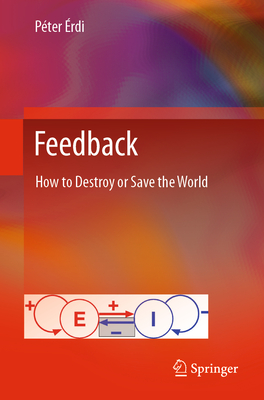
Feedback: How to Destroy or Save the World
暫譯: 反饋:如何毀滅或拯救世界
Érdi, Péter
- 出版商: Springer
- 出版日期: 2024-12-13
- 售價: $1,910
- 貴賓價: 9.5 折 $1,814
- 語言: 英文
- 頁數: 117
- 裝訂: Quality Paper - also called trade paper
- ISBN: 3031624386
- ISBN-13: 9783031624384
-
相關分類:
控制系統 Control-systems
海外代購書籍(需單獨結帳)
相關主題

商品描述
The book offers an exciting, non-technical intellectual journey around applying feedback control to emerging and managing local and global crises, thus keeping the world on a sustainable trajectory. There is a narrow border between destruction and prosperity: to ensure reasonable growth but avoid existential risk, we must find the fine-tuned balance between positive and negative feedback. This book addresses readers belonging to various generations, such as young people growing up in a world where everything seems to be falling apart; people in their 30s and 40s who are thinking about how to live a fulfilling life; readers in their 50s and 60s thinking back on life; and Baby Boomers reflecting on their past successes and failures.
Albert-László Barabási, Robert Gray Dodge Professor of Network Science, Northeastern University: "In a world where interconnectedness has fostered global prosperity, it has also introduced vulnerabilities that can escalate local failures into worldwide crises. "Feedback" by Peter Erdi explores this double-edged sword, offering a solution through the power of feedback mechanisms. These tools are designed to mitigate the negative impacts of connectedness, steering the complexity of modern life towards outcomes that enhance human welfare."
Patrick Grim, Philosopher in Residence Visiting Scholar Center for Complex Systems University of Michigan: "Érdi demonstrates that many of the critical problems we face--from climate crises to economic instability to the threat of terrorism--operate as runaway feedback loops. The first challenge is to understand them. The second is to introduce control mechanisms on the model of biological homeostasis--a different form of feedback--that will guide us toward a more sustainable social future. Érdi applies the analytic tools of complex systems to some of the most complex issues we face."
Ichiro Tsuda, Specially Appointed Professor at Sapporo City University, Sapporo, Japan, leaving Chubu University Academy of Emerging Sciences (Director and Professor), Chubu University, Japan: "This book is dangerous, because of making your own consideration on feedback impossible to stop by a continual feedback process of yourself. Nevertheless, you must be given a method of finding very narrow boundaries between prosperity and destruction, therefore this book is extremely valuable. We all must read."
商品描述(中文翻譯)
這本書提供了一個令人興奮的非技術性智識之旅,探討如何將反饋控制應用於新興的地方和全球危機管理,從而使世界保持在可持續的軌道上。毀滅與繁榮之間有一條狹窄的邊界:為了確保合理的增長而避免生存風險,我們必須找到正反饋之間的微妙平衡。本書針對不同世代的讀者,例如在一切似乎崩潰的世界中成長的年輕人;思考如何過上充實生活的30和40歲的人;回顧人生的50和60歲的讀者;以及反思過去成功與失敗的嬰兒潮一代。
**Albert-László Barabási**,美國東北大學網絡科學的Robert Gray Dodge教授:*「在一個互聯互通促進全球繁榮的世界中,它也引入了脆弱性,可能將地方性失敗升級為全球危機。彼得·厄爾迪的《反饋》探討了這把雙刃劍,通過反饋機制的力量提供了解決方案。這些工具旨在減輕互聯性帶來的負面影響,將現代生活的複雜性引導向增進人類福祉的結果。」*
**Patrick Grim**,密西根大學複雜系統中心的駐校哲學家:*「厄爾迪展示了我們面臨的許多關鍵問題——從氣候危機到經濟不穩定再到恐怖主義威脅——都是作為失控的反饋迴路運作。第一個挑戰是理解它們。第二個挑戰是引入類似生物穩態的控制機制——一種不同形式的反饋——以指導我們走向更可持續的社會未來。厄爾迪將複雜系統的分析工具應用於我們面臨的一些最複雜的問題。」*
**津田一郎**,日本札幌市立大學特任教授,曾任中部大學新興科學學院院長及教授:*「這本書是危險的,因為它使你無法停止對反饋的自我考量,這是一個持續的反饋過程。然而,你必須獲得一種方法來找到繁榮與毀滅之間非常狹窄的邊界,因此這本書極具價值。我們都必須閱讀。」*
作者簡介
Péter Érdi, born in Budapest, is a senior computational scientist appointed as Henry Luce Professor of Complex Systems Studies at Kalamazoo College in Kalamazoo, Michigan, since 2002. There, he teaches interdisciplinary classes in physics, psychology, computer science, and mathematics. He is also a research professor at the Department of Computational Sciences, HUN-REN Wigner Research Centre for Physics, Budapest, Hungary. Member of the Board of Governors of the International Neural Network Society (2012-2020), and Vice President of Membership of the Same Society in 2017-2018, in 2015-2019, Péter was the Editor-in-Chief of the Journal "Cognitive Systems Research", published by Elsevier. Editorial Board Member of the Journal BioSystems (Elsevier), and of the Springer book series "Springer Series in Synergetics" and "Understanding Complex Systems", he has hold about 200 invited lectures in the overlapping areas of computational, cognitive, and social sciences, in the United States, Europe, Asia, Africa, and South America. He is also the founding director of the Budapest Semester in Cognitive Science, a study abroad program established in 2003, which takes international students to Budapest for one semester. Author of some reputable and well-known books, such as Complexity Explained (Springer, 2008) and Stochastic Chemical Kinetics - Theory and (Mostly) Systems Biological Applications (with Gábor Lente, Springer, 2014), he recently published Ranking: The Unwritten Rules of the Social Game We All Play (Oxford University Press, 2020), which has been translated into Chinese, German, Hungarian, Japanese, and Korean, and Repair: When and How to Improve Broken Objects, Ourselves, and Our Society (with Zsuzsa Szvetelszky, Springer, 2022).
作者簡介(中文翻譯)
彼得·厄爾迪(Péter Érdi)出生於布達佩斯,自2002年以來擔任美國密歇根州卡拉馬祖學院(Kalamazoo College)複雜系統研究亨利·盧斯教授(Henry Luce Professor of Complex Systems Studies)。在那裡,他教授物理學、心理學、計算機科學和數學的跨學科課程。他同時也是匈牙利布達佩斯HUN-REN維根物理研究中心(Wigner Research Centre for Physics)計算科學系的研究教授。彼得曾於2012年至2020年擔任國際神經網絡學會(International Neural Network Society)理事會成員,並於2017年至2018年擔任該學會的會員副總裁。在2015年至2019年間,彼得擔任由Elsevier出版的期刊《Cognitive Systems Research》的主編。他還是期刊《BioSystems》(Elsevier)及Springer書系《Springer Series in Synergetics》和《Understanding Complex Systems》的編輯委員會成員,並在美國、歐洲、亞洲、非洲和南美洲的計算科學、認知科學和社會科學交叉領域發表了約200場受邀演講。他還是布達佩斯認知科學學期(Budapest Semester in Cognitive Science)的創始主任,這是一個於2003年成立的留學計畫,讓國際學生在布達佩斯學習一個學期。他是一些著名書籍的作者,如《Complexity Explained》(Springer, 2008)和《Stochastic Chemical Kinetics - Theory and (Mostly) Systems Biological Applications》(與加博·倫特(Gábor Lente)合著,Springer, 2014),最近出版的《Ranking: The Unwritten Rules of the Social Game We All Play》(牛津大學出版社,2020)已被翻譯成中文、德文、匈牙利文、日文和韓文,以及《Repair: When and How to Improve Broken Objects, Ourselves, and Our Society》(與茱茱莎·斯維特爾斯基(Zsuzsa Szvetelszky)合著,Springer, 2022)。