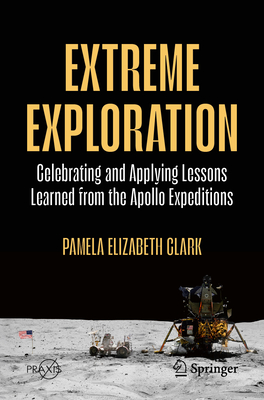
Extreme Exploration: Celebrating and Applying Lessons Learned from the Apollo Expeditions
暫譯: 極限探索:慶祝與應用阿波羅探險的經驗教訓

Clark, Pamela Elizabeth
  • 出版商: Springer
  • 出版日期: 2025-10-26
  • 售價: $1,210
  • 貴賓價: 9.8$1,185
  • 語言: 英文
  • 頁數: 289
  • 裝訂: Quality Paper - also called trade paper
  • ISBN: 3032017335
  • ISBN-13: 9783032017338
  • 相關分類: 物理學 Physics
  • 海外代購書籍(需單獨結帳)

相關主題

商品描述

This book describes a relatively unsung triumph of the Apollo program. The extreme limitation of resources available for exploring the lunar surface required the creation of an altogether new approach to science and exploration-- the "Apollo Approach," also known as the "Extreme Science Approach."

This book analyses the record of Apollo and essential pre-Apollo precursor (Ranger, Surveyor, Lunar Orbiter) programs, including firsthand interviews with the people involved; recently archived training, simulation, planning documentation; and the Apollo Lunar Surface Log, to show how the missions to the Moon created a novel baseline for field exploration. As we approach the new series of Artemis missions, the book looks forward, applying what Apollo taught us to the scientific exploration that will be conducted in the future. With each breakthrough, Apollo created the foundations not only for lunar missions, but for any space exploration activity that followed. This book will show you how it did so, and what's next.

商品描述(中文翻譯)

這本書描述了阿波羅計畫中一個相對不為人知的成功。探索月球表面所需的資源極為有限,這要求我們創造一種全新的科學與探索方法——「阿波羅方法」,也被稱為「極端科學方法」。

本書分析了阿波羅計畫的紀錄以及阿波羅之前的關鍵前驅計畫(如Ranger、Surveyor、Lunar Orbiter),包括與相關人員的第一手訪談;最近歸檔的訓練、模擬、計畫文件;以及阿波羅月球表面日誌,以展示前往月球的任務如何為現場探索創造了一個新基準。隨著我們接近新的阿爾忒彌斯任務系列,本書展望未來,將阿波羅所教導的應用於未來的科學探索。每一次突破,阿波羅不僅為月球任務奠定了基礎,也為隨後的任何太空探索活動奠定了基礎。本書將向您展示它是如何做到的,以及接下來會發生什麼。

作者簡介

Pamela E. Clark, PhD, grew up in New England and, inspired by President John Kennedy, decided to explore outer space. She thought, "If they can put a man on the moon, they can put a woman (me) on Mars!" She obtained her BA from St. Joseph College. There, she participated in organic geochemistry research with Dr. Mary Ellen Murphy, one of the developers of criteria for biogenicity for moon rocks, and coordinated an NSF inter-disciplinary undergraduate field research project. To obtain her PhD in planetary geochemistry (University of Maryland), she simulated, analyzed, correlated, and interpreted lunar X-ray spectra. She was a member of the group, led by Isidore Adler and Jack Trombka, that pioneered the use of orbital x-ray and gamma-ray spectrometers and participated in the USGS Astrogeology Branch Lunar Data Consortium, the first attempt to create a common format database for all the remote sensing data from a planetary body. After completing her PhD, she worked with the Goldstone Solar System Radar group, and expanded her remote sensing background to include radar, thermal and near infrared studies of planetary surfaces with particular emphasis on the study of Mercury's surface. Dr. Clark organized a briefing team to promote a mission to Mercury, for a while edited the Mercury Messenger newsletter. Following this, she became a member of a GSFC group led by Steve Curtis that developed innovative concepts for autonomous, compact, low-cost multi-platform tools, instrument packages, and missions for extreme environments. More recently, her background and long-term interest in lunar exploration led her to support the development of science requirements, operational scenarios, and architectures for the return to the Moon as part of various lunar initiatives, which provided the basis for this book. She has also led the promotion of the cubesat paradigm for deep space exploration in the planetary science community, developing the programs for the annual Lunar Cubes Workshops first sponsored by Flexure Engineering. She led the working group and was the Science PI for the NASA NextSTEP lunar orbiter Lunar IceCube built by the Space Science Center at Morehead State University and launched by ARTEMIS 1. Dr. Clark has worked at NASA GSFC and JPL, as well as at several universities during the course of her career, and is currently the director of the Star Theater and member of the technical staff of the Space Science Center at Morehead State University. Her major goal in life is to bring scientists, engineers, technologists, and entrepreneurs together to create sustainable exploration and utilization of deep space, with the Moon as a strategic stepping stone. Springer has published her books "Dynamic Planet: Mercury in the Context of its Environment", "Remote Sensing Tools for Exploration" (coauthored with Michael Rilee) and "Constant-Scale Natural Boundary Mapping in the Solar System and Beyond" (coauthored with Chuck Clark).

作者簡介(中文翻譯)

Pamela E. Clark, PhD,在新英格蘭長大,受到約翰·甘迺迪總統的啟發,決定探索外太空。她想:「如果他們能把人送上月球,那麼他們也能把一位女性(我)送上火星!」她在聖約瑟夫學院獲得學士學位。在那裡,她參與了與瑪麗·艾倫·墨菲博士的有機地球化學研究,後者是月球岩石生物性標準的開發者之一,並協調了一個國家科學基金會(NSF)跨學科的本科生實地研究項目。為了獲得行星地球化學的博士學位(馬里蘭大學),她模擬、分析、關聯並解釋了月球的X射線光譜。她是由伊西多爾·阿德勒和傑克·特朗布卡領導的團隊成員,該團隊開創了使用軌道X射線和伽馬射線光譜儀的先河,並參與了美國地質調查局(USGS)天體地質學分支的月球數據聯盟,這是首次嘗試為行星體的所有遙感數據創建通用格式數據庫。在完成博士學位後,她與金石太陽系雷達小組合作,並擴展了她的遙感背景,包括對行星表面的雷達、熱和近紅外研究,特別強調對水星表面的研究。克拉克博士組織了一個簡報小組,以推廣前往水星的任務,並曾編輯《水星信使》通訊。隨後,她成為由史蒂夫·柯蒂斯領導的GSFC小組成員,該小組開發了針對極端環境的自主、緊湊、低成本多平台工具、儀器包和任務的創新概念。最近,她的背景和對月球探索的長期興趣使她支持開發科學需求、操作場景和架構,以便作為各種月球計劃的一部分回到月球,這為本書提供了基礎。她還在行星科學社群中推廣了立方衛星(cubesat)範式,以進行深空探索,並開發了由Flexure Engineering首次贊助的年度月球立方衛星研討會的計劃。她領導了工作小組,並擔任NASA NextSTEP月球軌道器Lunar IceCube的科學首席研究員,該衛星由摩爾黑德州立大學的太空科學中心建造,並由ARTEMIS 1發射。克拉克博士在NASA GSFC和JPL工作過,並在她的職業生涯中在幾所大學任教,目前是摩爾黑德州立大學星際劇院的主任及太空科學中心的技術人員。她人生的主要目標是將科學家、工程師、技術專家和企業家聚集在一起,以創造可持續的深空探索和利用,以月球作為戰略的跳板。施普林格出版社已出版她的書籍《動態行星:水星及其環境的背景》、《探索的遙感工具》(與邁克爾·瑞利共同撰寫)和《太陽系及其以外的恆定比例自然邊界映射》(與查克·克拉克共同撰寫)。