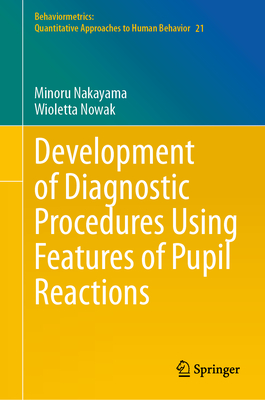
This monograph focuses on the development of diagnostic procedures for diseases related to retinal nerve conditions using features of waveforms of pupillary light reflex (PLR). Eye pupil reflection of light pulses is a well-known phenomenon, but the response mechanism is complicated. Some relationships of the features of chromatic light stimuli and activity of retinal ganglion cells influence the responses. As the features of pupil responses may represent the condition of nerve connections, these waveform shapes can detect symptoms of disease. The assistance of medical clinicians who have shared PLR data from patients of aged-macular degeneration (AMD) or patients with impaired cognitive function, as caused by Alzheimer's disease, for example, is gratefully acknowledged. The recorded temporal data of PLR waveforms were analyzed using multivariate analysis or data science techniques. As most participants were elderly or the number of measurements was insufficient, the signal processing required compensatory techniques. As a result, trials and re-analyses were carried out to better understand certain features. Although the best solutions have not yet been developed, the authors have decided to share the currently available procedures in this monograph and to solicit constructive suggestions for further improvement and development.
本專著專注於利用瞳孔光反射(PLR)波形特徵開發與視網膜神經狀況相關疾病的診斷程序。眼睛對光脈衝的瞳孔反射是一個眾所周知的現象,但其反應機制相當複雜。某些色光刺激的特徵與視網膜神經節細胞的活動之間存在關聯,這些關聯會影響反應。由於瞳孔反應的特徵可能代表神經連接的狀況,因此這些波形形狀可以檢測疾病的症狀。
我們感謝醫療臨床醫師的協助,他們分享了來自年齡相關性黃斑變性(AMD)患者或因阿茲海默症等原因導致認知功能受損患者的PLR數據。所記錄的PLR波形的時間數據使用多變量分析或數據科學技術進行分析。由於大多數參與者為老年人或測量次數不足,因此所需的信號處理需要補償技術。
因此,進行了試驗和重新分析,以更好地理解某些特徵。儘管尚未開發出最佳解決方案,作者決定在本專著中分享目前可用的程序,並徵求建設性的建議以進一步改進和發展。
Dr. Minoru Nakayama is a Professor Emeritus of the Institute of Science Tokyo, Japan, and his current affiliation (since 2025) is Meiji University in Tokyo, Japan. He completed the Master of Education program at Tokyo Gakugei University in 1985 and was awarded a Doctor of Engineering degree from the Tokyo Institute of Technology in 1990. Dr. Nakayama previously held positions within the Department of Information and Communications Engineering and CRADLE (the Centre for Research & Development of Educational Technology) at the Tokyo Institute of Technology, which was renamed the Institute of Science Tokyo in 2024. His scientific research interests include human visual perception, human-computer interaction (HCI), and educational technology. He has international research experience, having been a Visiting Researcher at the University of Sussex, UK, and LIRMM at the University of Montpellier, France. He holds memberships in various academic organizations, including the ACM, BERA, IEICE, and JPA.
Dr. Wioletta Nowak is an Assistant Professor at Department of Biomedical Engineering in Wroclaw University of Science and Technology.
She completed the Master of Technical Physics program at Wroclaw University of Science and Technology in 2000 and was awarded a Doctor of Physics degree from the Wroclaw University of Science and Technology in 2005.
Her scientific research interests include electromedical equipment construction, pupillometry, vision electrophysiology and cognititive study.
She has international research experience, having worked at the Tokyo Institute of Technology.
中山實博士是日本東京科學研究所的名譽教授,並於2025年起任職於日本東京的明治大學。他於1985年完成東京學藝大學的教育碩士課程,並於1990年獲得東京科技大學的工程博士學位。中山博士曾在東京科技大學的信息與通信工程系及教育科技研究與發展中心(CRADLE)任職,該校於2024年更名為東京科學研究所。他的科學研究興趣包括人類視覺感知、人機互動(HCI)和教育科技。他擁有國際研究經驗,曾在英國薩塞克斯大學和法國蒙彼利埃大學的LIRMM擔任訪問研究員。他是多個學術組織的成員,包括ACM、BERA、IEICE和JPA。
諾瓦克博士是波蘭弗羅茨瓦夫科技大學生物醫學工程系的助理教授。她於2000年完成弗羅茨瓦夫科技大學的技術物理碩士課程,並於2005年獲得該校的物理博士學位。她的科學研究興趣包括電醫療設備建造、瞳孔測量、視覺電生理學和認知研究。她擁有國際研究經驗,曾在東京科技大學工作。