-
出版商:
Springer
-
出版日期:
2025-11-01
-
售價:
$2,640
-
貴賓價:
9.5 折
$2,508
-
語言:
英文
-
頁數:
160
-
裝訂:
Hardcover - also called cloth, retail trade, or trade
-
ISBN:
9819683823
-
ISBN-13:
9789819683826
-
相關分類:
DeepLearning
商品描述
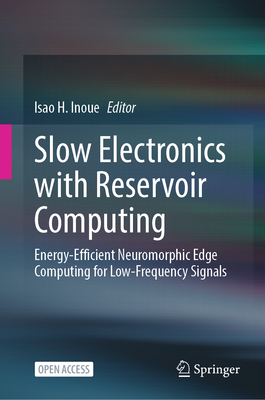
This book discusses "slow electronics", the study of devices processing signals with low frequencies. Computers have the remarkable ability to process data at high speeds, but they encounter difficulties when handling signals with low frequencies of less than 100Hz. They unexpectedly require a substantial amount of energy. This poses a challenge for such as biomedical wearables and environmental monitors that need real-time processing of slow signals, especially in energy-limited 'edge' environments with small batteries. One possible solution to this issue is event-driven processing, which entails the use of non-volatile memory to read/write data and parameters every time a slow (sporadic) signal is detected. However, this approach is highly energy-consuming and unsuitable for the edge environments. To address this challenge, the authors propose "slow electronics" by developing electronic devices and systems that can process low-frequency signals more efficiently. The biological brain is an excellent example of the slow electronics, as it processes low-frequency signals in real time with exceptional energy efficiency. The authors have employed reservoir computing with a spiking neural network (SNN) to simulate the learning and inference of the brain. The integration of slow electronics with SNN reservoir computing allows for real-time data processing in edge environments without an internet connection. This will reveal the determinism or periodicity behind unconscious behaviours and habits that have been difficult to explore due to privacy barriers thus far. Moreover, it may provide a more profound understanding of a craftsman's skills, which they may not even be aware of.
This book emphasises the most recent concepts and technological developments in slow electronics. Discussion on the captivating subject of slow electronics are given by delving into the complexities of reservoir calculation, analogue CMOS circuits, artificial neuromorphic devices, and numerical simulation with extended time constants, paving the way for more people-friendly devices in the future.
商品描述(中文翻譯)
本書討論「慢電子學」,即研究處理低頻信號的設備。電腦具備以高速處理數據的卓越能力,但在處理低於100Hz的低頻信號時卻面臨困難。意外的是,這些設備需要大量的能量。這對於如生物醫學可穿戴設備和環境監測器等需要實時處理慢信號的應用構成挑戰,尤其是在能量有限的小型電池「邊緣」環境中。
解決此問題的一種可能方案是事件驅動處理,這涉及在每次檢測到慢(偶發)信號時使用非揮發性記憶體來讀取/寫入數據和參數。然而,這種方法耗能極高,不適合邊緣環境。為了解決這一挑戰,作者提出了「慢電子學」,通過開發能更有效處理低頻信號的電子設備和系統。生物大腦是一個優秀的慢電子學範例,因為它能以卓越的能量效率實時處理低頻信號。作者使用帶有脈衝神經網絡(SNN)的水庫計算來模擬大腦的學習和推理。
將慢電子學與SNN水庫計算相結合,能在無需互聯網連接的邊緣環境中實現實時數據處理。這將揭示無意識行為和習慣背後的確定性或週期性,這些內容至今因隱私障礙而難以探索。此外,它可能提供對工匠技能的更深刻理解,這些技能他們自己可能都未曾意識到。
本書強調慢電子學中最新的概念和技術發展。通過深入探討水庫計算、類比CMOS電路、人工神經形態設備以及具有擴展時間常數的數值模擬的複雜性,對於迷人的慢電子學主題進行了討論,為未來更友好的設備鋪平了道路。
作者簡介
Isao H. Inoue received his degrees in physics from the University of Tokyo (BSc 1990, MSc 1992) and began his research career in 1992 at the Electrotechnical Laboratory, which later became part of AIST. He focused on strongly correlated electron systems, particularly Mott transitions, and was among the first to report superconductivity in La-doped SrTiO₃. He received his PhD in 1999 and subsequently spent two years at the University of Cambridge. Upon returning to AIST, he expanded his work from quantum materials to oxide electronics and neuromorphic devices. He developed oxide-based artificial neurons and introduced the concept of "Slow Electronics," which leverages slow ionic processes for ultra-low-power computing. He also serves as a Professor at the University of Tsukuba and a Visiting Professor at Tokyo University of Science, continuing to lead interdisciplinary research at the intersection of physics and brain-inspired electronics.
作者簡介(中文翻譯)
井上勇治(Isao H. Inoue)於東京大學獲得物理學學位(學士 1990年,碩士 1992年),並於1992年在電氣技術研究所(Electrotechnical Laboratory,後來成為AIST的一部分)開始他的研究生涯。他專注於強關聯電子系統,特別是莫特轉變(Mott transitions),並且是最早報告掺鋰(La-doped)SrTiO₃超導性的人之一。他於1999年獲得博士學位,隨後在劍橋大學(University of Cambridge)度過了兩年。回到AIST後,他將研究範圍從量子材料擴展到氧化物電子學和類神經元設備。他開發了基於氧化物的人工神經元,並引入了“慢電子學”('Slow Electronics')的概念,利用緩慢的離子過程進行超低功耗計算。他同時擔任筑波大學(University of Tsukuba)的教授以及東京理科大學(Tokyo University of Science)的訪問教授,持續在物理學與腦啟發電子學的交叉領域領導跨學科研究。