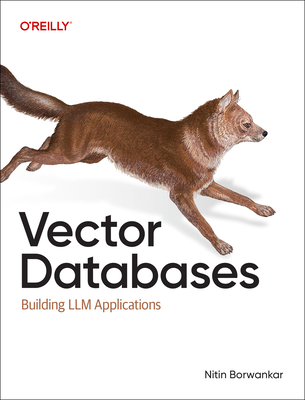
Vector Databases: A Practical Introduction (Paperback)
暫譯: 向量資料庫:實用入門(平裝本)
Borwankar, Nitin
- 出版商: O'Reilly
- 出版日期: 2026-06-02
- 定價: $2,450
- 售價: 9.0 折 $2,205
- 語言: 英文
- 頁數: 292
- 裝訂: Quality Paper - also called trade paper
- ISBN: 1098177592
- ISBN-13: 9781098177591
-
相關分類:
Large language model
立即出貨 (庫存 < 3)
買這商品的人也買了...
-
 jQuery Mobile 建置與執行 (jQuery Mobile: Up and Running)
$520$410 -
 改變未來 20年最重要的 20個視覺機器學習理論深讀
$490$417 -
 Arduino 官方正版 Genuino 101
$1,700$1,700 -
 演算法技術手冊, 2/e (Algorithms in a Nutshell: A Practical Guide, 2/e)
$580$458 -
 OpenCV 範例解析
$450$382 -
 OpenCV 3 學習手冊 (Learning OpenCV 3: Computer Vision in C++ with the OpenCV Library)
$1,200$948 -
 Raspberry Pi 3 Model B+ (UK製)
$1,720$1,685 -
 Deep Learning 深度學習基礎|設計下一代人工智慧演算法 (Fundamentals of Deep Learning: Designing Next-Generation Machine Intelligence Algorithms)
$620$490 -
 初探深度學習|使用 TensorFlow (TensorFlow for Deep Learning: From Linear Regression to Reinforcement Learning)
$480$379 -
 晉昇軟體最高殿堂:Jenkins2 持續整合大師之路
$600$474 -
 $1,320Deep Learning with JavaScript: Neural Networks in Tensorflow.Js
 -
 JavaScript 技術手冊
$560$476 -
 $1,584Microservices Security in Action
 -
 Principles of Distributed Database Systems, 4/e (Paperback)
$2,500$2,375 -
 $708基於 ISO26262 的功能安全
 -
 $1,840Multithreaded JavaScript: Concurrency Beyond the Event Loop
 -
 Understanding Distributed Systems : What every developer should know about large distributed applications, 2/e (Paperback)
$1,650$1,617 -
 OpenTelemetry 入門指南:建立全面可觀測性架構(iThome鐵人賽系列書)【軟精裝】(封面有些許摺痕,不介意在下單)
$750$585 -
 內行人才知道的機器學習系統設計面試指南 (Machine Learning System Design Interview)
$680$537 -
 $2,106Full Stack JavaScript Strategies: The Hidden Parts Every Mid-Level Developer Needs to Know (Paperback)
 -
 $2,205Beyond Vibe Coding: From Coder to Ai-Era Developer (Paperback)
 -
 $2,205Building Event-Driven Microservices: Leveraging Organizational Data at Scale
 -
 Latency: Reduce Delay in Software Systems (Paperback)
$2,260$2,147 -
 $2,147Just Use Postgres!: All the Database You Need (Paperback)
 -
 從 AI Agent 到多代理人系統設計|架構規劃與應用開發 (Building Applications with AI Agents: Designing and Implementing Multiagent Systems)
$780$616
相關主題

商品描述
The AI revolution is here, and at its core lies a game-changing technology that most developers haven't fully explored: vector databases. From powering semantic search to enabling large language models (LLMs) and generative AI, vector databases are reshaping how we build applications with unstructured data like text, images, and audio. But how do you go from curious to capable with this vital technology? That's where this book comes in.
In this hands-on guide, author Nitin Borwankar takes you through the "why, what, and how" of vector databases, starting with the basic theory behind vector embeddings and progressing to building applications with real-world tools. You'll learn about Word2vec, how to convert open source SQL databases like SQLite3 and PostgreSQL into vector databases, and integrate them into retrieval-augmented generation (RAG) applications. Whether you're a Python developer, data engineer, or ML practitioner, this book gives you the foundation to leverage vector databases confidently in your AI projects.
- Understand the connection between vector databases, embeddings, and LLMs
- Learn practical approaches for transforming SQL databases into vector databases
- Build RAG applications for both personal and enterprise use
- Apply vector databases to solve real-world AI challenges
- Learn how to use vector databases with LLMs to build applications
商品描述(中文翻譯)
AI 革命已經來臨,而其核心是一項改變遊戲規則的技術,大多數開發者尚未充分探索:向量資料庫。從驅動語意搜尋到支持大型語言模型(LLMs)和生成式 AI,向量資料庫正在重塑我們如何使用文本、圖像和音頻等非結構化數據來構建應用程式。但如何從好奇變得能夠掌握這項重要技術呢?這就是本書的目的所在。
在這本實用指南中,作者 Nitin Borwankar 將帶您了解向量資料庫的「為什麼、什麼和如何」,從向量嵌入的基本理論開始,逐步進入使用現實世界工具構建應用程式。您將學習 Word2vec,如何將開源 SQL 資料庫如 SQLite3 和 PostgreSQL 轉換為向量資料庫,並將其整合到檢索增強生成(RAG)應用程式中。無論您是 Python 開發者、數據工程師還是機器學習實踐者,本書都將為您提供在 AI 專案中自信利用向量資料庫的基礎。
- 了解向量資料庫、嵌入和 LLMs 之間的關聯
- 學習將 SQL 資料庫轉換為向量資料庫的實用方法
- 為個人和企業用途構建 RAG 應用程式
- 應用向量資料庫解決現實世界的 AI 挑戰
- 學習如何將向量資料庫與 LLMs 結合使用以構建應用程式