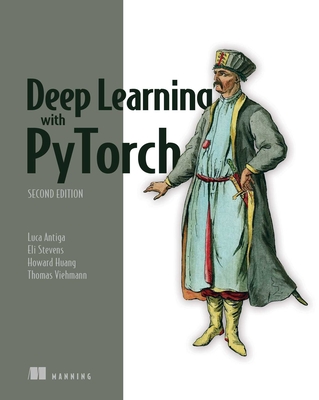
Deep Learning with Pytorch, 2/e (Paperback)
暫譯: 使用 Pytorch 的深度學習(第二版)
Antiga, Luca, Stevens, Eli, Huang, Howard
- 出版商: Manning
- 出版日期: 2026-03-10
- 售價: $2,260
- 貴賓價: 9.5 折 $2,147
- 語言: 英文
- 頁數: 600
- 裝訂: Quality Paper - also called trade paper
- ISBN: 1633438856
- ISBN-13: 9781633438859
-
相關分類:
DeepLearning
立即出貨
買這商品的人也買了...


相關主題

商品描述
Get a free eBook (PDF or ePub) from Manning as well as access to the online liveBook format (and its AI assistant that will answer your questions in any language) when you purchase the print book.
PyTorch core developer Howard Huang updates the bestselling original Deep Learning with PyTorch with new insights into the transformers architecture and generative AI models.
Instantly familiar to anyone who knows PyData tools like NumPy, PyTorch simplifies deep learning without sacrificing advanced features. In this book you'll learn how to create your own neural network and deep learning systems and take full advantage of PyTorch's built-in tools for automatic differentiation, hardware acceleration, distributed training, and more. You'll discover how easy PyTorch makes it to build your entire DL pipeline, including using the PyTorch Tensor API, loading data in Python, monitoring training, and visualizing results. Each new technique you learn is put into action with practical code examples in each chapter, culminating into you building your own convolution neural networks, transformers, and even a real-world medical image classifier.
In Deep Learning with PyTorch, Second Edition you'll find:
- Deep learning fundamentals reinforced with hands-on projects
- Mastering PyTorch's flexible APIs for neural network development
- Implementing CNNs, transformers, and diffusion models
- Optimizing models for training and deployment
- Generative AI models to create images and text
About the technology
The powerful PyTorch library makes deep learning simple--without sacrificing the features you need to create efficient neural networks, LLMs, and other ML models. Pythonic by design, it's instantly familiar to users of NumPy, Scikit-learn, and other ML frameworks. This thoroughly-revised second edition covers the latest PyTorch innovations, including how to create and refine generative AI models.
About the book
Deep Learning with PyTorch, Second Edition shows you how to build neural network models using the latest version of PyTorch. Clear explanations and practical projects help you master the fundamentals and explore advanced architectures including transformers and LLMs. Along the way you'll learn techniques for training using augmented data, improving model architecture, and fine tuning.
What's inside
- PyTorch APIs for neural network development
- LLMs, transformers, and diffusion models
- Model training and deployment
About the reader
For Python programmers with a background in machine learning.
About the author
Howard Huang is a software engineer and developer on the PyTorch library focusing on large scale, distributed training. Eli Stevens, Luca Antiga, and Thomas Viehmann authored the first edition of Deep Learning with PyTorch.
Table of Contents
Part 1
1 Introducing deep learning and the PyTorch library
2 Pretrained networks
3 It starts with a tensor
4 Real-world data representation using tensors
5 The mechanics of learning
6 Using a neural network to fit the data
7 Telling birds from airplanes: Learning from images
8 Using convolutions to generalize
Part 2
9 How transformers work
10 Diffusion models for images
11 Using PyTorch to fight cancer
12 Combining data sources into a unified dataset
13 Training a classification model to detect suspected tumors
14 Improving training with metrics and augmentation
15 Using segmentation to find suspected nodules
16 Training models on multiple GPU
商品描述(中文翻譯)
購買印刷版書籍時,您將獲得Manning提供的免費電子書(PDF或ePub),以及在線liveBook格式的訪問權限(及其AI助手,能以任何語言回答您的問題)。
PyTorch核心開發者Howard Huang更新了暢銷書《Deep Learning with PyTorch》,提供了有關變壓器架構和生成式AI模型的新見解。
對於熟悉PyData工具如NumPy的人來說,PyTorch使深度學習變得簡單,而不犧牲高級功能。在本書中,您將學習如何創建自己的神經網絡和深度學習系統,並充分利用PyTorch內建的自動微分、硬體加速、分散式訓練等工具。您將發現,使用PyTorch構建整個深度學習管道是多麼簡單,包括使用PyTorch Tensor API、在Python中加載數據、監控訓練和可視化結果。您學到的每一項新技術都會在每一章中通過實用的代碼示例付諸實踐,最終讓您能夠構建自己的卷積神經網絡、變壓器,甚至一個實際的醫學影像分類器。
在Deep Learning with PyTorch, Second Edition中,您將找到:
- 透過實作專案強化深度學習基礎
- 精通PyTorch靈活的API以進行神經網絡開發
- 實作CNN、變壓器和擴散模型
- 優化模型以進行訓練和部署
- 生成式AI模型以創建圖像和文本
關於技術
強大的PyTorch庫使深度學習變得簡單,且不犧牲創建高效神經網絡、LLMs和其他機器學習模型所需的功能。設計上符合Python風格,對於NumPy、Scikit-learn和其他機器學習框架的用戶來說,立即變得熟悉。本次徹底修訂的第二版涵蓋了最新的PyTorch創新,包括如何創建和完善生成式AI模型。
關於本書
Deep Learning with PyTorch, Second Edition展示了如何使用最新版本的PyTorch構建神經網絡模型。清晰的解釋和實用的專案幫助您掌握基礎知識,並探索包括變壓器和LLMs在內的高級架構。在此過程中,您將學習使用增強數據進行訓練、改善模型架構和微調的技術。
內容概覽
- 用於神經網絡開發的PyTorch API
- LLMs、變壓器和擴散模型
- 模型訓練和部署
關於讀者
適合具有機器學習背景的Python程序員。
關於作者
Howard Huang是PyTorch庫的軟體工程師和開發者,專注於大規模、分散式訓練。Eli Stevens、Luca Antiga和Thomas Viehmann是Deep Learning with PyTorch第一版的作者。
目錄
第一部分
1 介紹深度學習和PyTorch庫
2 預訓練網絡
3 從張量開始
4 使用張量表示現實世界數據
5 學習的機制
6 使用神經網絡擬合數據
7 從圖像中辨別鳥類與飛機
8 使用卷積進行泛化
第二部分
9 變壓器的工作原理
10 用於圖像的擴散模型
11 使用PyTorch對抗癌症
12 將數據源合併為統一數據集
13 訓練分類模型以檢測可疑腫瘤
14 通過指標和增強改善訓練
15 使用分割找到可疑結節
16 在多個GPU上訓練模型
作者簡介
Luca Antiga is co-founder and CEO of an AI engineering company located in Bergamo, Italy, and a regular contributor to PyTorch.
Eli Stevens has worked in Silicon Valley for the past 15 years as a software engineer, and the past 7 years as Chief Technical Officer of a startup making medical device software.
Howard Huang is a software engineer and developer on the PyTorch library. During his tenure at PyTorch he has focused on large scale, distributed training.
Thomas Viehmann is a Machine Learning and PyTorch speciality trainer and consultant based in Munich, Germany and a PyTorch core developer.
作者簡介(中文翻譯)
Luca Antiga 是位於義大利貝爾加莫的一家人工智慧工程公司的共同創辦人及執行長,同時也是 PyTorch 的定期貢獻者。
Eli Stevens 在矽谷工作了 15 年,擔任軟體工程師,並在過去 7 年擔任一家開發醫療設備軟體的初創公司的首席技術官。
Howard Huang 是 PyTorch 函式庫的軟體工程師和開發者。在他於 PyTorch 的任期內,專注於大規模的分散式訓練。
Thomas Viehmann 是一位專注於機器學習和 PyTorch 的專業訓練師及顧問,常駐於德國慕尼黑,並且是 PyTorch 的核心開發者。