商品描述
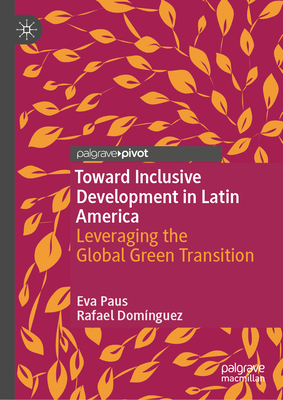
"A major contribution to the analysis of how to fulfill the triple dimensions of sustainable development: economic growth, social development, and environmental sustainability."--José Antonio Ocampo, Professor at Columbia University, former Minister of Finance of Colombia, former UN Under-Secretary-General for Economic and Social Affairs, and former Executive Secretary of the Economic Commission for Latin America and the Caribbean The global green transition presents a unique opportunity for resource-rich Latin American nations to leverage natural assets to reduce problematic structural barriers while expanding social inclusion and strengthening responses to climate change. This book examines why coordinated and proactive development strategies--aligned with emerging global sustainability imperatives--are essential for achieving these goals. It outlines the contours of an inclusive green development strategy, placing a green developmental state at the center and emphasizing the role of broadly defined industrial policies. Drawing on heterodox economics and international political economy, Eva Paus and Rafael Domínguez analyze how Latin American governments can respond to current economic and geopolitical pressures. Systemic change is possible if states adopt environmental-developmental roles, pursue active non-alignment, and engage in more coordinated foreign policy efforts. Readers will gain insight into the political and economic conditions that shape the feasibility of inclusive green development. The resulting book breaks down the strategic choices available to governments seeking to integrate sustainability with long-term economic transformation and inclusion. It offers a grounded perspective on how policy direction, institutional capacity, and international positioning can be used to navigate the challenges of our times.
商品描述(中文翻譯)
「對於如何實現可持續發展的三重維度:經濟增長、社會發展和環境可持續性,做出了重要貢獻。」--何塞·安東尼奧·奧坎波,哥倫比亞大學教授,前哥倫比亞財政部長,前聯合國經濟和社會事務副秘書長,以及前拉丁美洲和加勒比經濟委員會執行秘書
全球綠色轉型為資源豐富的拉丁美洲國家提供了一個獨特的機會,利用自然資產來減少問題性的結構性障礙,同時擴大社會包容性並加強應對氣候變化的能力。
本書探討了為何協調和主動的發展策略——與新興的全球可持續性要求相一致——對於實現這些目標至關重要。它勾勒出一個包容性綠色發展策略的輪廓,將綠色發展國家置於中心,並強調廣義工業政策的角色。艾娃·保斯(Eva Paus)和拉斐爾·多明格斯(Rafael Domínguez)借鑒異端經濟學和國際政治經濟學,分析了拉丁美洲政府如何應對當前的經濟和地緣政治壓力。
如果國家採取環境-發展角色,追求積極的非對齊政策,並參與更協調的外交政策努力,系統性變革是可能的。讀者將深入了解塑造包容性綠色發展可行性的政治和經濟條件。這本書分析了政府在尋求將可持續性與長期經濟轉型和包容性整合時可用的戰略選擇。它提供了一個基於現實的觀點,說明政策方向、制度能力和國際定位如何用來應對我們時代的挑戰。
作者簡介
Eva Paus is Professor of Economics Emerita at Mount Holyoke College, USA. Her recent research has focused on economic development in the context of globalization in the face of structural change, innovation, and the middle-income trap in Latin America and beyond. She is the author of several books, including Global Capitalism Unbound, Confronting Dystopia, and Foreign Investment, Development, and Globalization. Paus has collaborated with ECLAC, ILO, UNIDO, and UNDP. Rafael Domínguez is Professor of Economic History and Institutions in the Department of Economics at the University of Cantabria, Spain. He is a Fellow of the Social Science Doctoral Program at the University of Salamanca, Spain. Domínguez leads the international research group on South-South Cooperation and Regional Integrations of the Spanish Network of Development Studies, and he has collaborated with CEPAL, GIZ, Europeaid, and the international development cooperation agencies of Mexico and Chile.
作者簡介(中文翻譯)
艾娃·保斯是美國霍利奧克學院的經濟學名譽教授。她最近的研究專注於全球化背景下的經濟發展,面對結構變遷、創新以及拉丁美洲及其他地區的中等收入陷阱。她是幾本書的作者,包括《全球資本主義無界限》(Global Capitalism Unbound)、《面對反烏托邦》(Confronting Dystopia)以及《外國投資、發展與全球化》(Foreign Investment, Development, and Globalization)。保斯曾與拉丁美洲和加勒比經濟委員會(ECLAC)、國際勞工組織(ILO)、聯合國工業發展組織(UNIDO)和聯合國開發計劃署(UNDP)合作。
拉斐爾·多明格斯是西班牙坎塔布里亞大學經濟系的經濟歷史與制度教授。他是西班牙薩拉曼卡大學社會科學博士課程的研究員。多明格斯領導西班牙發展研究網絡的南南合作與區域整合國際研究小組,並與拉丁美洲和加勒比經濟委員會(CEPAL)、德國國際合作機構(GIZ)、歐洲援助(Europeaid)以及墨西哥和智利的國際發展合作機構合作。